There is an increasing pressure on the world's natural resources, and global CO₂ emissions still seem to be rising. Both businesses and society must use less, smarter. Digital infrastructure accounts for a significant share of both carbon emissions and resource use. To meet these challenges, principles from circular and sharing economy must be integrated into companies' business models.
A service model for resource-efficient digitalization
Intility is an industrialized platform service that takes comprehensive operational responsibility for companies' IT environments. It covers everything from workstations and network equipment to data centers and cloud, facilitating high resource utilization, optimized energy use, and extended equipment lifespan. We systematically work with environmentally friendly procurement, reuse, recycling, and smart logistics – and report emissions and resource use across the entire value chain. By consolidating many companies' IT environments onto an automated and virtualized platform, the environmental footprint and resource use can be reduced compared to individual, dedicated solutions. This enables our customers to make more sustainable choices – not only at the server level but also for all equipment and services included in the digital workplace. For customers, this means lower emissions, better resource use, and a sustainable alternative to traditional solutions. For cloud services, calculations show that the Intility platform provides a total CO₂ reduction of 53% per year over the hardware's five-year lifespan, compared to operating on dedicated hardware in Norway.
*The calculation is based on a typical example of a customer environment on our cloud platform. Dedicated equipment at locations, meeting room screens, local network equipment, and personal devices are excluded from the calculation.
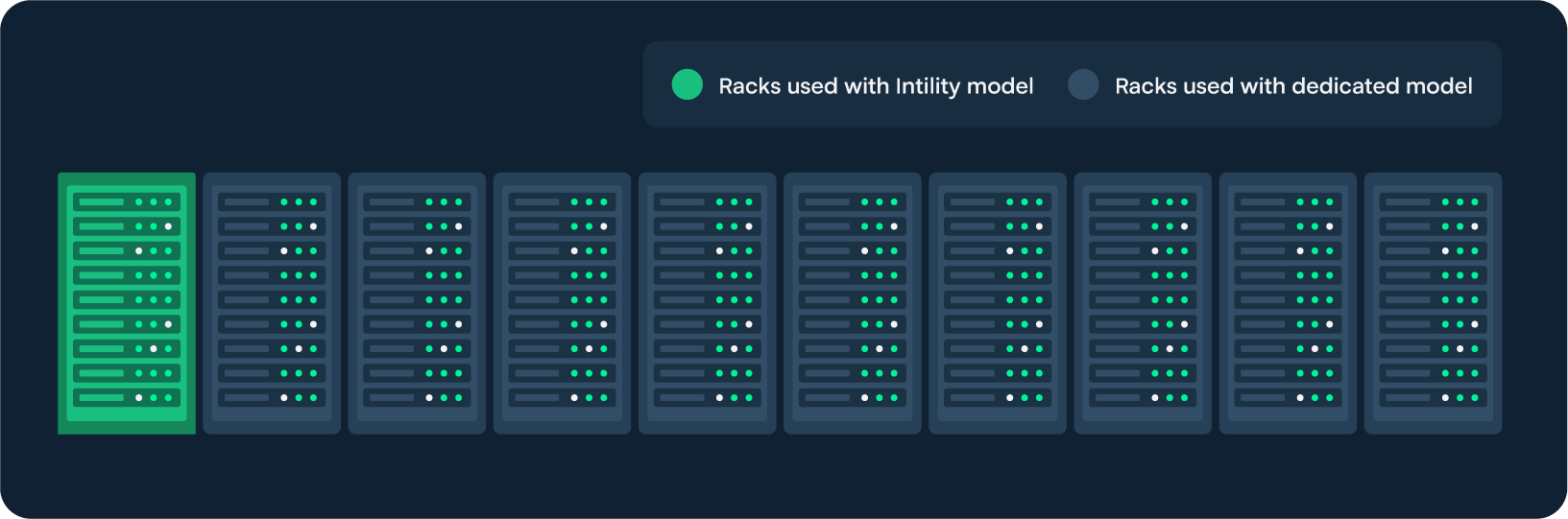
The visualization below shows what resource efficiency means in practice. In a traditional, dedicated setup, each customer would need their own racks with servers, firewalls, VPN concentrators, domain and network controllers, and other infrastructure components – typically without overbooking and with limited redundancy. On Intility’s shared, virtualized platform, these functions are centralized and delivered as shared, fully redundant services without single points of failure. This enables far higher utilization of each physical server and rack. In the example, the same capacity can be delivered with roughly one tenth of the physical footprint and space, while simultaneously increasing robustness and security.
Folketrygdfondet on the new IT service platform
Folketrygdfondet, which manages 11% of the main index on the Oslo Stock Exchange with 64 employees, has recently migrated from a dedicated server environment to Intility's shared, virtualized cloud platform. Below, the environmental and productivity gains this brings are outlined, along with the underlying assumptions.
What do the numbers show?
- Annual carbon footprint from operating servers and digital infrastructure has been reduced by approximately 47%.
- The number of virtual machines has decreased from 121 to 54, without reducing capacity or security.
- Annual hardware footprint has decreased from 3386 kgCO₂e to 2110 kgCO₂e**.
- Carbon footprint from electricity and resource consumption has decreased from 1188 kgCO₂e to 301 kgCO₂e.
**The figures are based on standardized emission factors and assumptions about usage. The gains will vary between businesses.
What lies behind the improvement?
- Shared platform: Multiple businesses are consolidated on a shared, virtualized infrastructure. This leads to higher resource utilization and reduces the need for physical servers and electricity consumption.
- Shared services: Many tasks that previously required dedicated VMs, such as security, backup, and monitoring, are now delivered as efficient shared services. Thus, fewer VMs are needed without compromising functionality or security.
- Resource optimization: Storage and compute resources can be adjusted based on actual usage, allowing Folketrygdfondet to only use the capacity they need – and continuously adjust this as needed.
- Simplified and freed operations: Less administration and monitoring provide more time for value-adding work for internal IT resources.
- Actual climate footprint: The calculations include Folketrygdfondet's share of resource and energy consumption from the shared services, ensuring that the environmental gain is accurately calculated.
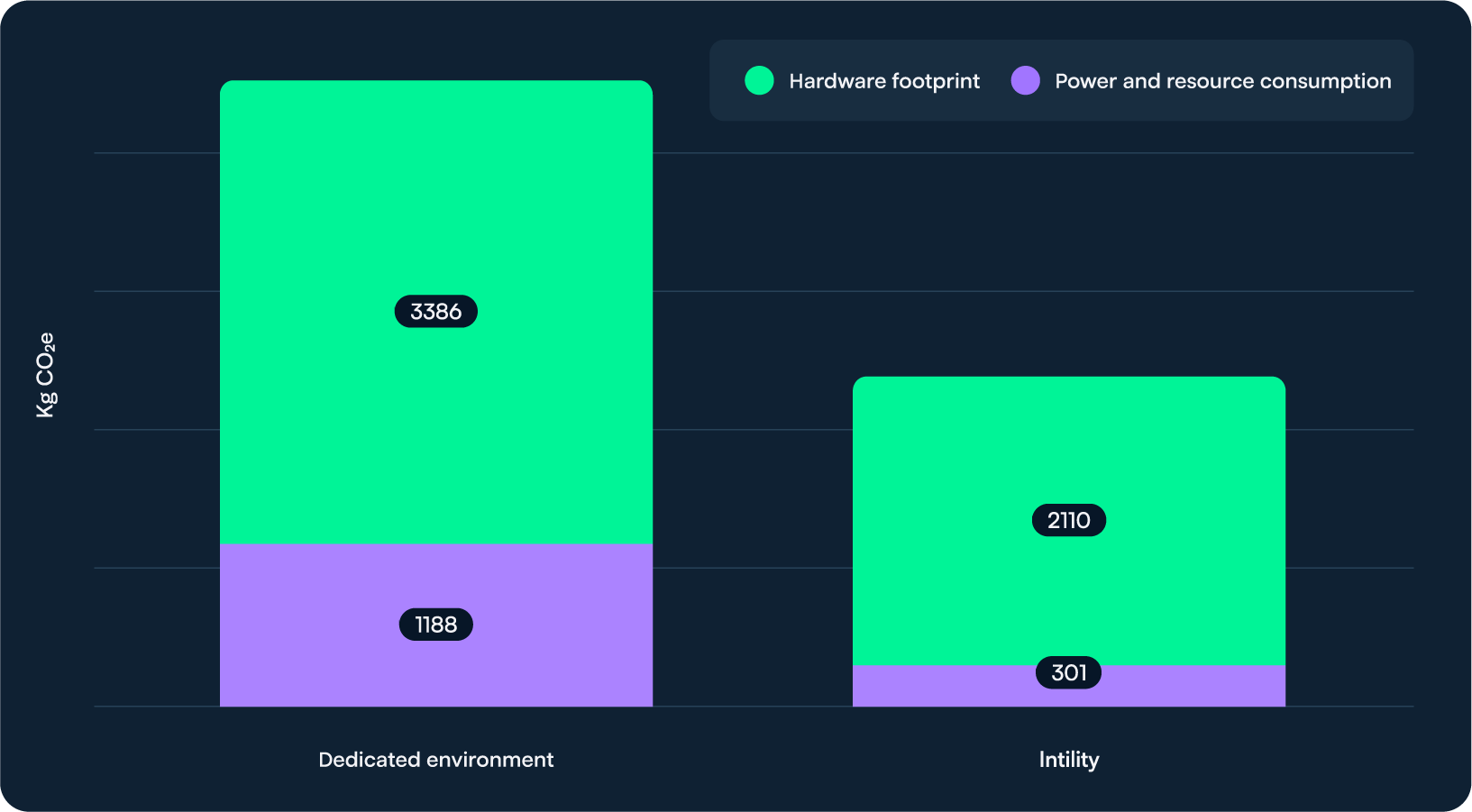
The figure shows a scenario for Folketrygdfondet, where a migration to Intility resulted in a halving of the carbon footprint due to a more resource-efficient design and therefore less need for hardware and electricity.
Folketrygdfondet on the migration
Rune Helgeland, head of Business Support at Folketrygdfondet, states the following about the transition to Intility: "Part of our IT strategy is to implement sustainable solutions that reduce the climate footprint and promote responsible business practices. Folketrygdfondet has chosen to outsource the IT infrastructure to achieve a stable, secure, and climate-friendly technological infrastructure."
Our disclaimers
The results apply to the specific assumptions in this example. Different usage and load patterns yield different results. We do not have zero emissions, and the platform still requires energy and equipment. We continuously work to reduce this, and we believe in transparency about both improvements and limitations.
- The article compares envisions two scenarios:
- Setup on Intility's virtualized, multi-tenant platform
- Setup on a new dedicated, local setup in redundant design
- The emissions are per year distributed over 5 years of hardware lifespan.
- It is assumed that dedicated design would not utilize overbooking (unlike Intility's practice).
- The setup on Intility allows for centralized components, including switches, VPN concentrators, domain controllers, and firewalls.
Want to know more?
Would you like to know more about how a shared and optimized cloud platform can reduce both climate footprint and resource use in your business? We would love to hear from you.